
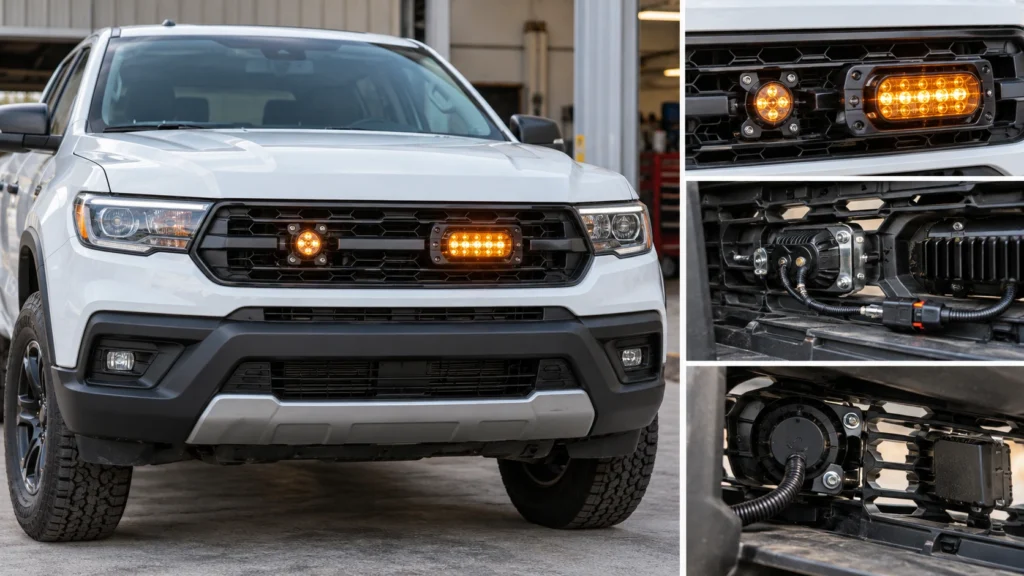
A warning light may look small on a product page and still be awkward to fit behind a grille or beside existing lamps. For tight installations, the choice between compact warning lights and full-size units is about more than the visible housing. The space behind the mounting surface, the direction of the signal, the wiring route and access for future service all matter. A larger light can be the simpler choice if it has a clear mounting position; a compact module can solve a space problem when the installation is planned as a whole.
Start with the space the vehicle actually offers
Before comparing lights, inspect the proposed location from the front and from behind. A grille opening might fit a small round lens while leaving little room for its cable, driver, or mounting hardware. Body panels may also curve or flex, affecting how securely a light sits. Measure the usable flat area and check what occupies the space behind it, including brackets, sensors, and existing wiring.
Think about where the light needs to be seen. A module tucked deep inside a grille may have a clear view straight ahead but be hidden from an approaching vehicle at an angle. If the mounting position blocks much of the lens, reconsider the position before choosing a more powerful product to compensate.
For example, imagine a service van with narrow gaps around its front grille. A compact module may fit neatly near a corner, but a grille slat could obscure it from the side. Moving the module closer to the outer edge may be more useful than placing a larger lamp in the same recessed spot.
What compact modules do well
Compact warning lights give installers options where a conventional lamp housing will not fit. They can suit grille openings, vehicle corners or small work equipment with limited mounting surfaces. Some products offer more than one mounting method, which can help when a flat panel and an angled bracket are both possible.
One example is a small round orange warning module with a listed diameter of 3.8 cm. It comes with a collar and an L-bracket as mounting options. It has an in-line driver, supports multiple flash patterns, and can be synchronized with other compatible modules. Those details illustrate why the space needed for installation includes the cable and driver as well as the visible lamp.
Small size does not remove the need to consider coverage. A single directional module points its signal toward a particular viewing area. Depending on the vehicle and intended use, several well-placed modules may make more sense than one hidden in the most convenient opening.
Where a full-size light can be easier
A larger warning light needs more exposed space, but that can be an advantage when the vehicle has a suitable roof or broad mounting area. Its position may make it easier to see from several directions without finding multiple small locations around the body. It may also be easier to inspect and clean than a module recessed behind a grille.
A roof-mounted warning light is a different installation project from a small grille module. Check the available mounting surface, the intended cable route, and whether nearby equipment could block the light. On a work vehicle that already carries tools or other roof equipment, placement deserves particular attention.
Size alone does not tell you how far away a light can be seen or whether it suits a particular job. Product design, viewing angle, mounting height and obstructions all affect the result.
Compare the complete installation
The most useful comparison is between finished arrangements, not loose products on a bench. Check these points before committing to either format:
- Visibility: Which directions must receive a clear signal, and will the bodywork or equipment hide the lens from any of them?
- Mounting: Is there enough stable surface for the supplied hardware, with access to fasteners during installation and later service?
- Wiring: Where will the cable, connector, and any driver sit? Can the route avoid rubbing, pinching, and exposed damage?
- Power and controls: Does the selected light match the vehicle’s electrical system, and how will its flash pattern be operated?
- Upkeep: Can you clean the lens and check the mounting without dismantling unrelated parts?
These checks also prevent a common mistake: treating a compact lamp as a direct substitute for a larger warning setup simply because both produce flashing orange light. A smaller housing may require more careful positioning or multiple units to serve the intended viewing directions. Conversely, buying a large light first can leave an installer struggling to find a sound place for it.
Consider a compact machine with little roof space and a grille partly occupied by other equipment. Several small modules could offer workable mounting positions, provided each has an unobstructed view and a protected wiring route. A larger light might reduce the number of separate mounting points, but only if the machine has a suitable exposed surface. For more detailed information on this topic, read our guide on Why LED Interior Lights Are a Practical Vehicle Upgrade.
Choose for the job and the vehicle
Warning equipment should be selected for its intended application as well as its fit. Review the product’s stated voltage, mounting instructions, and relevant approvals for the use you have in mind. Approval markings on a product do not settle every question about how a complete vehicle installation should be arranged, so assess the finished layout before relying on it.
For a tight installation, begin with available space and required viewing directions, then decide which light format can meet both. Compact modules offer flexibility in narrow locations; full-size lights can simplify placement when a clear, substantial mounting area exists. The better choice is the arrangement that remains visible, secure, and practical to maintain after it is installed.