
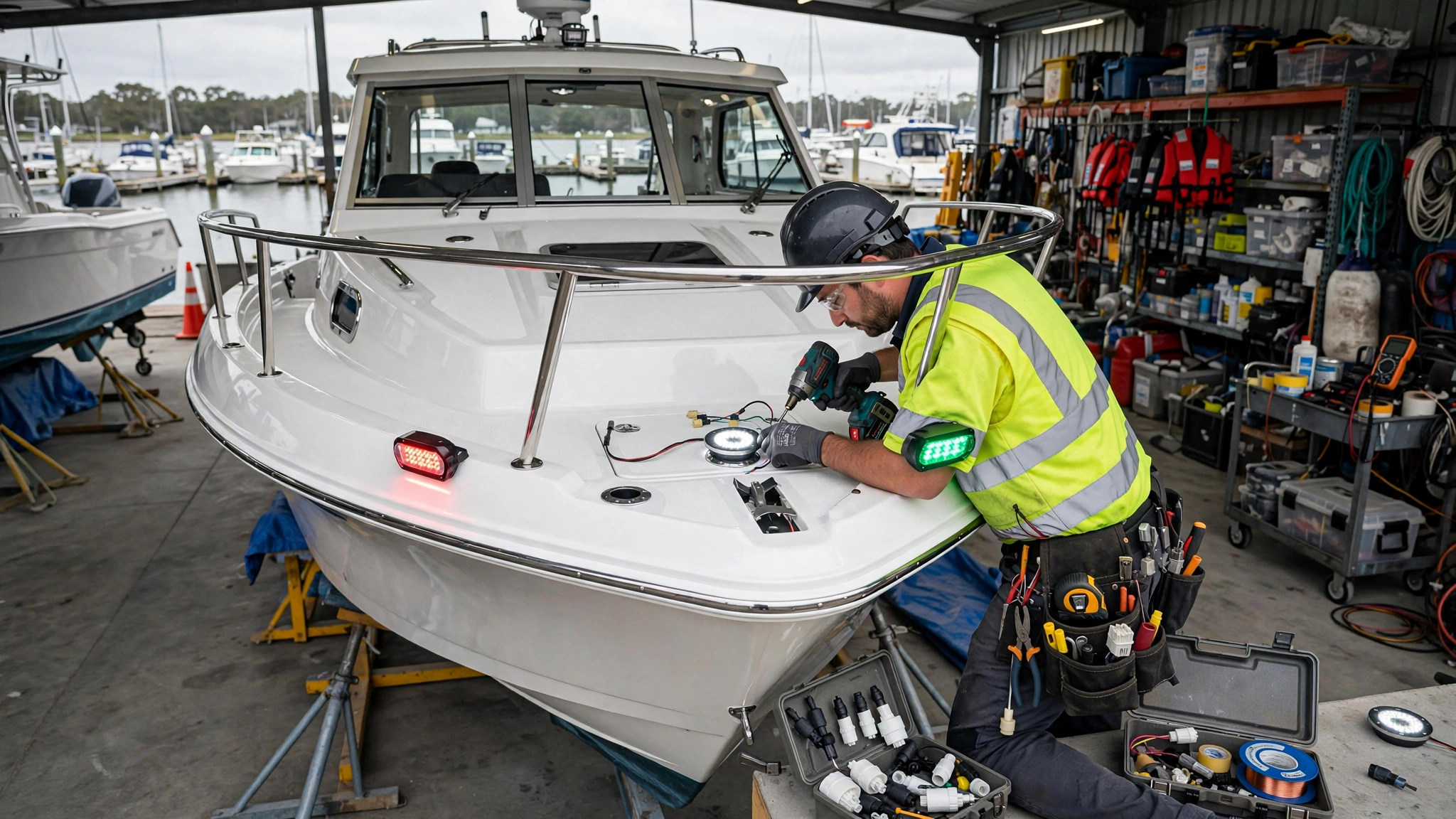
Professional Boat Lighting Service for Safe and Reliable Marine Use
Boat lighting service provides complete installation, repair, replacement, and maintenance solutions for marine vessels used in recreational, commercial, and construction-related environments. Boats operating near construction sites, harbours, docks, bridges, offshore platforms, and waterfront projects require dependable lighting to support safe navigation and efficient work.
Marine lighting systems must perform reliably in demanding conditions. Saltwater, rain, vibration, humidity, temperature changes, and constant exposure to moisture can damage standard electrical components. For this reason, boat lights, wiring, switches, connectors, and mounting hardware must be suitable for marine use.
A professional service begins with an inspection of the boat’s existing lighting and electrical system. The assessment helps identify damaged components, poor connections, weak illumination, electrical overloads, and areas that require additional lighting. The final solution is planned according to the boat’s size, purpose, power supply, and operating environment.
Complete Marine Lighting Solutions
Navigation Light Installation
Navigation lights are essential for helping other vessels identify a boat’s position, direction, and movement in low-light conditions. These lights are normally fitted at specific points around the vessel and must provide clear visibility without obstruction.
The service may include the installation or replacement of port, starboard, stern, masthead, and all-round white lights. Each light is positioned carefully to provide the correct viewing angle and reliable performance.
Wiring is protected from moisture and secured away from moving equipment or sharp surfaces. After installation, every navigation light is tested to confirm correct colour, brightness, switch operation, and visibility from the required direction.
LED Deck Light Fitting
LED deck lights improve visibility across working areas, walkways, storage sections, and loading zones. They are especially useful on boats used for marine construction, inspection, repair, fishing, transport, and equipment handling.
LED lights provide strong illumination while consuming relatively little electrical power. This makes them suitable for boats with limited battery capacity or vessels that operate for long periods without engine charging.
Deck lights can be mounted overhead, along rails, beneath canopies, or near working equipment. The position and beam angle are adjusted to reduce shadows and provide even lighting without causing excessive glare.
Searchlight and Spotlight Installation
Searchlights and spotlights provide focused long-distance illumination. They help operators identify navigation markers, floating debris, shorelines, structures, equipment, and other vessels during darkness or poor visibility.
These lights may be manually adjustable or controlled remotely from the cabin. Remote-controlled units allow the operator to change the direction of the beam without leaving the steering position.
Professional installation includes fitting strong mounting brackets, protected wiring, dedicated switches, relays, and suitable circuit protection. The light is then aligned and tested to ensure smooth movement and dependable performance.
Lighting for Marine Construction Work
Work Light Installation
Boats used near construction projects often require powerful work lights to illuminate tools, machinery, materials, and surrounding structures. Standard cabin or deck lights may not provide enough brightness for detailed tasks.
Flood beam lights are commonly used because they spread illumination across a wide area. Spot beam lights can be added when workers need to see further ahead or inspect distant structures.
Work lights may be installed on the bow, stern, roof, mast, side rails, or temporary support frames. Every light must be secured against vibration and movement while remaining accessible for cleaning and maintenance.
Underwater Lighting Solutions
Underwater lights can improve visibility around the hull, working platforms, and submerged structures. They may support inspection, maintenance, diving, recovery, and marine construction activities.
These lights must be fully sealed and designed to operate beneath the waterline. Poor-quality fittings or incorrect installation can allow water to enter the light housing or boat structure.
The installation process includes selecting a suitable location, sealing cable entry points, protecting electrical connections, and testing the system for leaks. Correct installation improves visibility while reducing the risk of electrical damage.
Docking and Loading Area Lights
Docking and loading lights help boat operators approach piers, pontoons, work barges, and construction platforms more safely. They also support the movement of tools, materials, and personnel between the boat and shore.
These lights are normally positioned to illuminate the sides, rear, or forward working area without shining directly into the operator’s eyes. Wide-angle units provide better coverage around attachment points, ropes, ladders, and loading surfaces.
Strong, weather-resistant fixtures are selected to withstand regular contact with water spray and harsh marine conditions.
Safe Marine Electrical Installation
Waterproof Wiring and Connections
Boat lighting systems require a higher level of moisture protection than standard vehicle lighting. Water entering connectors or cable joints can cause corrosion, voltage loss, short circuits, and complete system failure.
Marine-grade cables, heat-shrink connectors, sealed plugs, and corrosion-resistant terminals are used to improve reliability. Wiring routes are planned to avoid fuel lines, hot surfaces, moving parts, and areas where equipment may damage the cables.
All cables are secured with suitable clips to prevent movement caused by vibration and rough water conditions.
Relay and Fuse Protection
High-powered boat lights should be connected through properly rated relays and fuses. This protects switches and wiring from excessive electrical current.
Separate circuits may be used for navigation lights, deck lights, work lights, cabin lights, and searchlights. Dividing the system into individual circuits makes fault diagnosis easier and prevents one damaged light from disabling the entire lighting system.
Fuse ratings and cable sizes are selected according to the total power demand and distance from the battery.
Battery and Charging System Assessment
Additional lighting increases the electrical demand placed on the boat’s batteries and charging system. Before installing multiple lights, the power supply should be checked to confirm it can support the extra load.
The assessment may include battery condition, alternator output, voltage levels, cable condition, and current power consumption. Weak batteries or charging faults should be corrected before new lights are added.
This helps prevent battery discharge, flickering lights, slow engine starting, and electrical instability.
Boat Lighting Repair and Maintenance
Lighting Fault Diagnosis
Marine lights may stop working because of blown fuses, damaged switches, poor earth connections, corroded terminals, broken cables, water entry, or failed light units.
Professional diagnosis identifies the exact cause of the problem. Voltage, continuity, grounding, and circuit performance are tested before repairs are completed.
Accurate fault detection avoids unnecessary replacement and restores reliable lighting more efficiently.
Corrosion and Water Damage Repair
Saltwater and moisture can quickly damage unprotected electrical components. Corroded connections often cause dim lights, intermittent operation, and overheating.
Repair work may include cleaning terminals, replacing damaged connectors, resealing cable entry points, drying light housings, and installing new marine-grade components.
Regular maintenance helps prevent small corrosion problems from developing into larger electrical failures.
Lens Cleaning and Beam Adjustment
Dirt, salt deposits, algae, and water stains can reduce light output. Cleaning lenses restores brightness and improves visibility without requiring immediate replacement.
Searchlights, work lights, and deck lights may also require realignment after vibration or impact. Correct adjustment ensures the beam covers the intended area and does not create unnecessary glare.
Benefits of Professional Boat Lighting
Improved Navigation Safety
Reliable lighting helps operators identify hazards, markers, structures, and nearby vessels. It also makes the boat easier for others to see during darkness or poor weather.
Better Working Conditions
Well-positioned work and deck lights allow crews to handle tools, materials, ropes, and equipment more safely. Improved visibility supports accurate and efficient marine construction operations.
Long-Term Electrical Reliability
Marine-grade components and professional installation reduce the risk of corrosion, short circuits, and unexpected light failure. Proper maintenance further extends the life of the complete system.
Reliable Boat Lighting Service for Marine Operations
Final Testing and Inspection
After installation or repair, every light and electrical circuit is tested. The inspection includes brightness, beam direction, switch operation, voltage stability, fuse protection, mounting security, and waterproof connections.
A complete boat lighting service provides dependable illumination for navigation, construction work, docking, inspection, and general marine use. Correctly installed lighting improves safety, productivity, visibility, and confidence in demanding marine environments.