
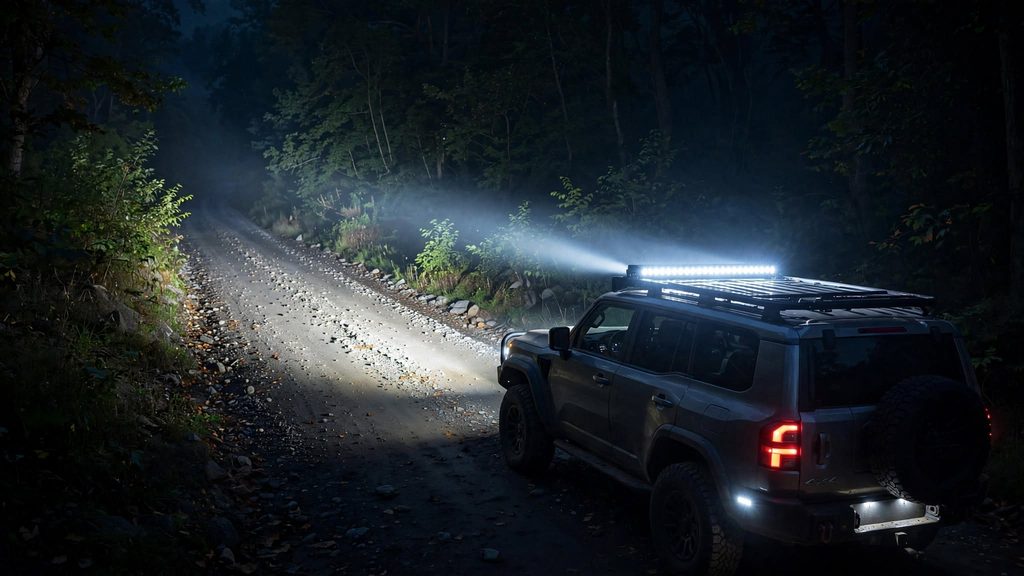
Driving after sunset can become difficult when standard headlights do not provide enough visibility for the road or conditions ahead. Poorly lit rural roads, changing weather, long-distance travel, and off-road routes can make it harder to identify bends, obstacles, animals, or changes in the road surface early enough to react comfortably.
LED driving lights are auxiliary lights designed to supplement a vehicle’s existing headlights. Choosing them involves more than selecting a bright-looking light or a large light bar. Beam pattern, installation position, durability, electrical compatibility, and intended driving conditions all affect how useful the lights will be. Understanding these factors makes it easier to choose LED driving lights that improve nighttime visibility without creating unnecessary glare.
Start With Your Actual Driving Conditions
Before comparing specifications, consider where and how the vehicle is normally driven. A driver travelling mainly on long, straight rural roads has different lighting requirements from someone navigating narrow tracks or winding roads.
For long-distance visibility, a concentrated beam that projects light farther ahead may be useful. On slower roads with frequent bends, broader illumination can help the driver see road edges and surrounding areas.
Off-road driving may require a combination of both. The goal should therefore be useful light distribution rather than simply maximum output.
Understand LED Driving Light Beam Patterns
Beam pattern is one of the most important considerations when choosing auxiliary vehicle lighting. It determines where the light actually goes.
Spot Beams for Distance
A spot beam concentrates illumination into a relatively narrow area ahead of the vehicle. This pattern is suited to situations where seeing farther down a dark road is important.
However, a narrow beam provides less illumination toward the sides. It may therefore be less suitable as the only auxiliary lighting on winding roads or trails.
Flood Beams for Wider Visibility
Flood beams spread illumination across a wider area. They can make road edges, nearby terrain, and objects outside the central line of travel easier to see.
The trade-off is that the light is less concentrated at longer distances. Flood lighting is often more useful at lower speeds where broad awareness matters more than long-range visibility.
Combination Beams
Combination driving lights incorporate characteristics of spot and flood patterns. They provide forward illumination while also spreading some light toward the sides.
For drivers who regularly encounter several types of roads, a balanced beam can be more practical than choosing an extremely narrow or wide pattern.
Look Beyond Brightness Specifications
Brightness is easy to compare on a product page, but it should not be the only deciding factor. An extremely bright LED driving light can still perform poorly if its optics distribute light inefficiently.
Consider how the reflector, lens, and LED arrangement control the beam. A controlled pattern puts illumination where the driver needs it instead of scattering excessive light upward or into areas that provide little practical benefit.
Glare also matters. Incorrectly aimed auxiliary lights can reduce comfort for the driver and create problems for other road users. Proper positioning and adjustment are therefore just as important as the light itself.
Choose the Appropriate Size and Mounting Position
LED light bars and individual driving lamps are available in many shapes and sizes. Larger does not automatically mean more suitable.
First examine the available mounting space. Common installation areas include the front bumper, grille, or dedicated mounting brackets. The selected position should allow the light to operate without obstructing airflow, vehicle sensors, cameras, or other equipment.
Mounting hardware also needs to hold the lights securely. Frequent vibration can cause poorly mounted lights to shift, which changes the beam direction and may reduce visibility.
After installation, the lights should be carefully aimed rather than simply pointed straight ahead at an arbitrary height.
Check Electrical Compatibility
Auxiliary LED lighting adds another electrical load to the vehicle. Before installation, check that the lights, wiring, switches, relay arrangement, and protection devices are appropriate for the vehicle’s electrical system.
A proper installation should use wiring suited to the expected current and include appropriate circuit protection. Connections exposed to moisture, dust, or road contamination also need suitable protection.
Modern vehicles can have complex electronic systems, so installation may require additional consideration when integrating auxiliary lights with existing high-beam controls or other vehicle electronics. Professional installation can be worthwhile when electrical compatibility is uncertain.
Consider Durability for the Environment
Driving lights are installed in an exposed part of a vehicle. They may encounter rain, dust, mud, vibration, road debris, temperature changes, and repeated washing.
Examine the construction of the housing, lens, mounting hardware, connectors, and seals rather than focusing only on the LEDs. For vehicles regularly used on rough roads, mounting strength and resistance to vibration become particularly important.
Heat management is another consideration. LEDs produce less wasted heat in the form of radiated light than some older lighting technologies, but their electronic components still generate heat. A well-designed housing should manage that heat effectively during operation.
Think About Light Color and Driving Comfort
Color temperature influences how LED illumination appears to the driver. Very cool white light can create a different visual experience from a more neutral white output.
The most suitable choice depends partly on driving conditions and personal comfort. Instead of choosing lights simply because their color appears especially white or blue, consider whether road markings, surface details, and obstacles remain easy to distinguish.
Weather matters as well. Light interaction with rain, fog, dust, or airborne particles can affect visibility, so greater brightness does not always translate into clearer vision.
Check Road-Legal Requirements Before Installation
Rules governing auxiliary driving lights vary between locations. Regulations may cover mounting position, when additional lights can be used, how they operate with high beams, and whether certain types of lights are permitted on public roads.
This distinction is particularly important for equipment designed primarily for off-road use. A light suitable for a private trail or work site may not necessarily be appropriate for normal road use.
Checking local vehicle-lighting requirements before purchasing can prevent choosing equipment that cannot legally be used as intended.
Practical Tips for Making the Final Choice
When comparing LED driving lights, focus on the complete lighting setup rather than one impressive specification.
Consider:
- The roads and environments where you regularly drive
- Whether you need long-range, wide-angle, or combination illumination
- Available mounting space and bracket strength
- Beam control and adjustability
- Electrical requirements and wiring quality
- Resistance to water, dust, vibration, and road conditions
- Compatibility with local road-lighting regulations
A well-matched light with a controlled beam can be more useful than a higher-output unit that does not suit the vehicle or driving environment.
Conclusion
Choosing the right LED driving lights for safe driving in the dark requires balancing visibility, beam pattern, installation, electrical compatibility, and durability. Brightness matters, but it should be considered alongside where the illumination is directed and how comfortably the driver can use it.
Start with your normal driving conditions, then select a beam pattern and physical design that match those needs. Pay attention to secure mounting, appropriate wiring, careful aiming, and local regulations. This approach helps create an auxiliary lighting setup that improves useful nighttime visibility without relying on excessive brightness or unnecessary features.